
 Sathi
Summarize this blog post with:
Table of contents
- The short version
- How we measured AI search traffic
- AI bots stopped collecting and started fetching
- What AI search crawlers actually read
- The AI search traffic gap: citations without clicks
- The few clicks were buyers
- What we're changing
- Common mistakes when reading AI bot data
- See your own AI search traffic in DidYouSEO
- FAQ
Between July 14 and November 2, 2026, AI bots fetched 20,140 pages on didyouseo.com. Bing says Copilot cited us about 3,200 times in the last three months. Over the same 16 weeks, AI answers sent us 15 visitors.
This post is our own AI search traffic data, in full: which AI bots read the site, how that changed month by month, what they read, and how few people clicked through. No industry averages, just one small SEO tool's logs. At the end there's what we're changing because of it, and how to check your own numbers.
The short version
| What we measured | July 14 - November 2, 2026 |
|---|---|
| Page fetches by AI bots (content pages only) | 20,140 |
| Growth in AI search crawler fetches, July → October | 32x (157 → 5,084 a month) |
| Copilot citations (Bing AI Performance, last 3 months) | ~3,200 |
| Visits from ChatGPT, Gemini, Perplexity and Claude answers | 15 |
| Clicks from Bing web search (Aug 3 - Nov 1) | 3, from 180 impressions |
Three things stood out. AI bots stopped collecting and started fetching. Fetches and citations went up a lot, and clicks barely moved. And the few people who did click came ready to buy.
How we measured AI search traffic
We used three sources, and each one sees a different part of the picture:
- Server-side bot logs. Our own bot traffic tracker records every request from a known bot, with the bot's name and the page it asked for. Analytics tools that run in the browser can't see bots, because bots don't run JavaScript. We explained why in does ChatGPT actually crawl your website.
- PostHog analytics for human visits that arrived from an AI assistant, by referrer or by the
utm_source=chatgpt.comtag ChatGPT adds to links. - Bing Webmaster Tools for Copilot citations and Bing web search clicks.
We took three things out so they wouldn't inflate the numbers. First, 2,345 requests to /mcp: that's our MCP server being used as a tool from Claude and ChatGPT, not anyone reading a page. Second, robots.txt, sitemap and llms.txt fetches. Third, my own visits, plus two "visits" that were really people signing in to connect our MCP server.
AI bots stopped collecting and started fetching
Here are content-page fetches per month, grouped by what the bot is for. July starts on the 14th.
| Month (2026) | Training crawlers | AI search crawlers | Fetches for a user's chat | Visitors from AI answers |
|---|---|---|---|---|
| July | 2,354 | 157 | 42 | 0 |
| August | 2,850 | 336 | 319 | 2 |
| September | 4,796 | 1,500 | 483 | 3 |
| October | 1,544 | 5,084 | 389 | 9 |
Training crawlers (GPTBot, ClaudeBot, Meta-ExternalAgent, CCBot) collect pages to train future models. They peaked in September, then fell by two thirds in October. GPTBot alone went from 396 fetches in July to 88 in October.
AI search crawlers fetch pages so an assistant can answer now. OpenAI's OAI-SearchBot went from 177 fetches in July to 4,372 in October, and PerplexityBot from 41 to 939. If you're unsure which OpenAI bot does what, we compared GPTBot, ChatGPT-User and OAI-SearchBot side by side. OpenAI's own crawler documentation describes the same split.
Fetches for a user's chat come from ChatGPT-User, Claude-User and Perplexity-User, when someone's conversation makes the assistant open a page. ChatGPT-User grew from 33 to 356 a month.
Put together: in July, training crawlers fetched 15 times more pages than search crawlers. By October it had flipped, and search crawlers fetched more than three times as many as training crawlers. On our site, live search is now most of the work.
What AI search crawlers actually read
We expected OAI-SearchBot to fetch our most-cited blog posts. It didn't. Since September its top pages were:
| Page | OAI-SearchBot fetches |
|---|---|
| Homepage | 200 |
| /sign-up | 119 |
| /features | 112 |
| /tools | 109 |
| /pricing | 108 |
| /sign-in | 105 |
| /about, /blog, /docs | ~100 each |
| /privacy, /terms, /contact | ~86 each |
The fetches are spread almost evenly, 80 to 120 per page, including the sign-in page and the privacy policy. That's a bot re-reading the whole site on a schedule, not following what users ask about. Not one blog post made its top 20.
What this means for you: your homepage, pricing and feature pages are what AI search reads most often. If those pages are vague, that vagueness is what goes into the answer.
The AI search traffic gap: citations without clicks
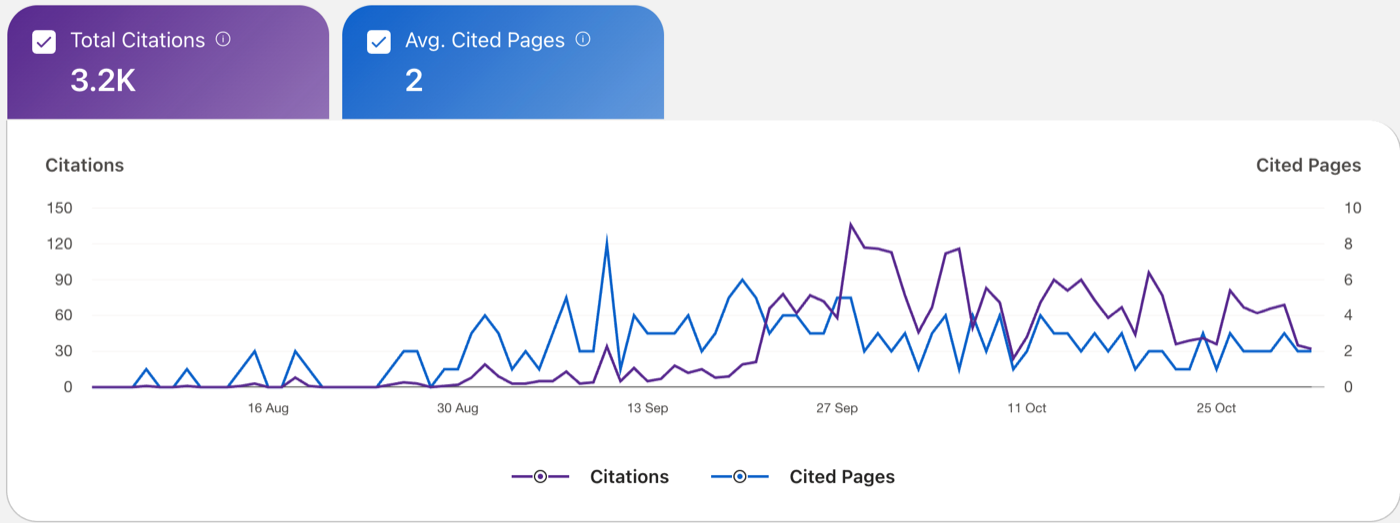
Bing's AI Performance report counts about 3,200 Copilot citations in three months, averaging two cited pages a day. The jump came in late September, and in the four weeks after it about 9 in 10 citations pointed at a single post: how to search for a word on a web page. Copilot quotes it to people asking how to use Ctrl+F. It's a useful answer. It's also an answer nobody needs to click.
Clicks, by source:
| Source | Visitors, July 14 - Nov 2 |
|---|---|
| ChatGPT | 14 |
| Gemini | 1 |
| Perplexity | 0 |
| Claude | 0 |
| Bing (web search and Copilot together) | 9 |
That's 15 visitors from AI assistant answers, plus 9 from Bing. Bing's own report counts only 3 of those 9 as web search clicks, so Copilot sent us a handful at most.
Compared per company:
- OpenAI: about 8,000 fetches across its three bots, and 14 visits. That's roughly 580 fetches per visitor. Cloudflare measured OpenAI at about 1,091 crawls per referral across the web in July 2025, so we're doing better than average, from a low base.
- Anthropic: 2,552 page fetches, 0 visitors.
- Perplexity: 1,815 fetches, 0 visitors. Perplexity documents its two bots in its crawler guide.
- Meta: 7,775 fetches by Meta-ExternalAgent, 0 visitors. Meta's crawler page says the bot is used to train AI models, so that's expected.
This matches what bigger studies find. Pew Research found Google users clicked a result on 8% of visits with an AI summary, against 15% without one. We wrote about why more links in AI answers don't mean more clicks in our Google AI Mode links update post.
The few clicks were buyers
Here's what surprised us. The 15 people who clicked through from an AI answer didn't land on the blog posts AI cites most. They landed on:
- /pricing
- our free SEO report template
- our post comparing cheap SEO tools with prices
- our Black Friday deals post
- /sign-up and the MCP server page
People who click out of an AI answer have usually already decided what they want. They're checking a price or starting a sign-up. A Ctrl+F how-to earns thousands of citations and no visits. A pricing page earns a few citations, and the people behind them are close to a decision.
What we're changing
- We keep AI search crawlers allowed. Blocking OAI-SearchBot or PerplexityBot takes you out of those answers. You can still block training crawlers if you want. Check which AI crawlers your robots.txt blocks before you change it.
- We're rewriting the pages AI reads most. The homepage, pricing and feature pages are getting a direct answer at the top, with real numbers: plan limits, check counts, prices. That's what an assistant needs in order to describe us correctly.
- We measure fetches, not just clicks. Clicks from AI are too few to show a trend. Fetches by AI search crawlers show whether you're in the pool at all, and that's the number that moved 32x.
- We count ChatGPT by its UTM tag too. ChatGPT adds
utm_source=chatgpt.comto links. Some of our ChatGPT visits had no referrer and showed up only through that tag.
Common mistakes when reading AI bot data
- Counting tool use as reading. Our
/mcpendpoint got 2,345 AI requests. Without filtering it out, Claude-User looks like it read our site 1,400 times in October. It actually opened 35 pages. - Treating citations as traffic. 3,200 Copilot citations sounds big. Almost all of them answered a question in full, without a click.
- Lumping all AI bots together. Training fetches fell while search fetches rose 32x. Add them up and you'd see "AI traffic is flat" and miss the shift.
- Trusting the bot name blindly. Anyone can claim to be GPTBot in a user agent. Our tracker verifies some bots by IP so far, not all of them, so treat small, odd-looking spikes with suspicion.
- Counting your own visits. A few of our "ChatGPT visits" were me, opening my own dashboard from a ChatGPT link. Filter your own sessions first.
See your own AI search traffic in DidYouSEO
The numbers in this post come from DidYouSEO's bot traffic tracking, which is on every plan, including Free. Add a small snippet to your site and you'll see which AI bots fetch which pages, every day, split into training, search and user fetches. For the wider picture of who reads your site, see our bot traffic statistics for 2026.
FAQ
How much traffic does AI search send to websites?
Very little, on our data. AI bots fetched 20,140 pages on our site in 16 weeks, and AI answers sent 15 visitors. Pew found Google users click a result on 8% of visits with an AI summary, against 15% without one.
Which AI crawler visits websites the most?
On our site in October 2026, OpenAI's OAI-SearchBot, with 4,372 fetches. In July, training crawlers fetched 15 times more pages than search crawlers. By October, search crawlers fetched more than three times as many.
Should I block AI crawlers?
Block training crawlers if you don't want your content used to train models. Keep search crawlers like OAI-SearchBot, PerplexityBot and Claude-SearchBot allowed, or you won't appear in those assistants' answers.
How do I track visitors from ChatGPT?
Look for the referrer chatgpt.com and the UTM tag utm_source=chatgpt.com in your analytics. ChatGPT adds the tag to links it shows. Some visits arrive with only one of the two.
Do AI citations bring traffic?
Rarely. Copilot cited us about 3,200 times in three months, mostly for a how-to answered in full inside the chat. The few visitors AI sent us went to pricing and sign-up pages, not to the most-cited post.
 DidYouSEO
Rank on Google. Show up in AI search.
Audit your site, track Search Console data and see if AI assistants mention you, in one dashboard.
- ChatGPT
- Claude
- Gemini
- Perplexity
No credit card required